Support foundational understanding of overwhelm
teaching practiceFor student year
Helps students to
- recognise body clues
- understand own emotions and body clues
- develop skills to self-regulate
Helps teachers to
- support student learning
- deepen learner profiles
- record student body clues
Summary
Some students (particularly young students, but also those with traumatic backgrounds, alexithymia, or autistic students) may not be able to recognise feelings of dysregulation until they become overwhelmed. Creating a regulation scale with learners can help staff and the learner to understand and/or identify when and why they are relaxed and ready to learn, are becoming dysregulated, or are too dysregulated/overwhelmed to learn. Regulation scales should be reviewed each term and updated if there are changes. Scales can be created as class, small group, or as a 1:1 activity, depending on the educator’s knowledge of the students. For younger learners, thinking about why they are in each zone (internal and external contexts) and how they know they are in that zone (internal and external body signals) can be completed before tackling the whole regulation scale.
For junior primary students, the involvement of parents/carers is essential, as much of the information in the regulation scale is based on observation of the child in context. The aim of the regulation scale is to guide classroom management strategies and support effective co-regulation and the development of self-regulation skills.
Alexithymia refers to a difficulty in identifying, processing, and expressing one’s own emotions, as well as differentiating those feelings from bodily sensations.
How the practice works
Watch: Creating a regulation scale (Healthy Possibilities, 2026)
Duration: 4.07
Australian Professional Standards for Teachers related to this practice
1.1 Physical, social and intellectual development and characteristics of students
1.2 - Understand how students learn
3.7 - Engage parents/carers in the educative process
4.1 - Support student participation
4.3 - Manage challenging behaviours
For further information, see Australian Professional Standards for Teachers AITSL page.
Preparing to teach
This activity can be introduced using any story book that focuses on a character’s big emotions, such as When Sophie Gets Angry – Really, really Angry… by Molly Bang, also available on YouTube: https://youtu.be/dNfd8WFDBAY?si=S0tcKBW6z2niJTlN
Whilst sharing the story, when the character experiences big emotions, ask the children;
- Can you tell what the emotion is from the pictures or words?
- What in the picture shows you how Sophie (or relevant character’s name) is feeling?
- What made Sophie feel like that?
- Do you think Sophie is ready to learn? Why/why not?
- Do you think Sophie is having big emotions, or is she overwhelmed completely? Explain that overwhelm can be called a number of things such as; meltdown, shutdown, survival mode.
Meltdown is survival mode behaviour that is externalising, such as flight or fight. Shutdowns are internalising behaviour in survival mode, such as freeze, flop, or drop. Fawning behaviour is another survival mode behaviour in which the person is compliant through fear.
With the learners, complete either the Big Emotions or Survival Mode template for Sophie (or the relevant character) and then they can complete one for themselves, with adult support. Students can draw or write or glue pictures or icons into the two areas to answer the questions. See the Resources tab below for a printable version and a PowerPoint version.
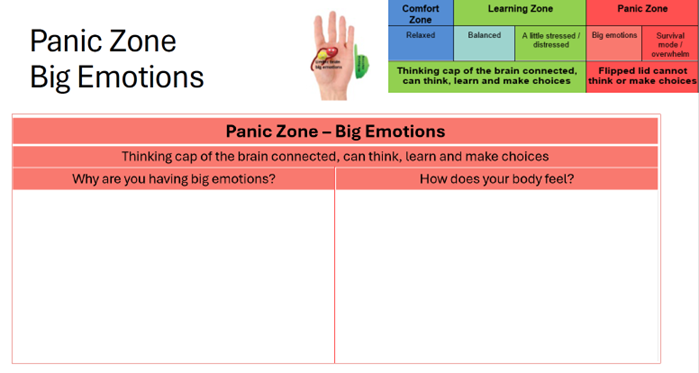
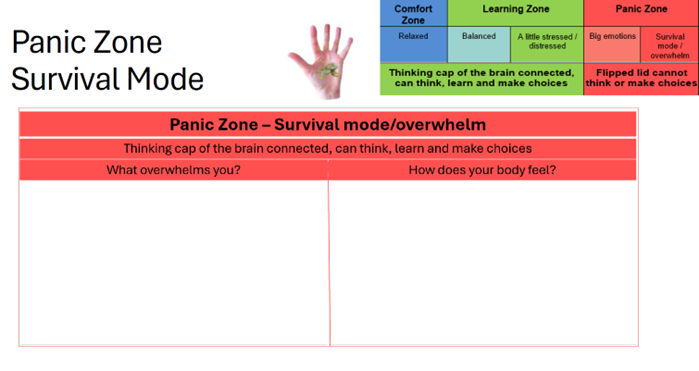
These resources have been provided for use by Healthy Possibilities.
Once the children have completed both the Panic Zone templates, they can be introduced to the Comfort and Learning Zone templates. Learners can individually identify personal body signals and behaviours that show when they are relaxed, ready to learn, a bit stressed, or overwhelmed. For each zone, the educator can model an example, using the prompt questions on the templates.
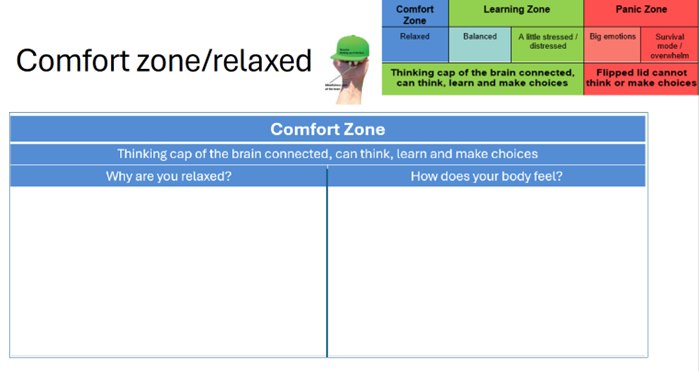
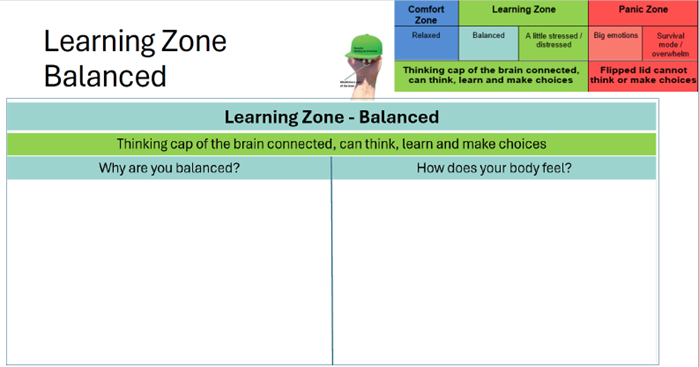
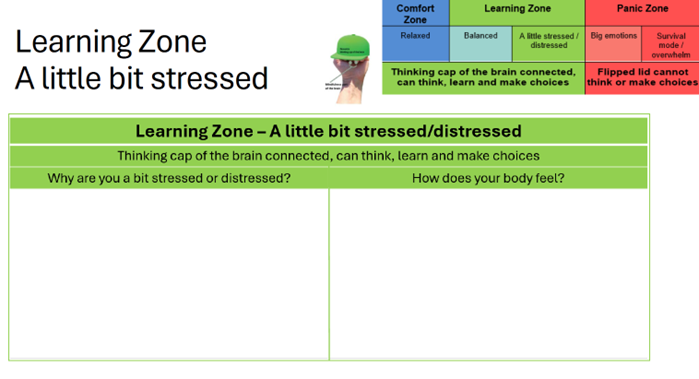
These resources have been provided for use by Healthy Possibilities.
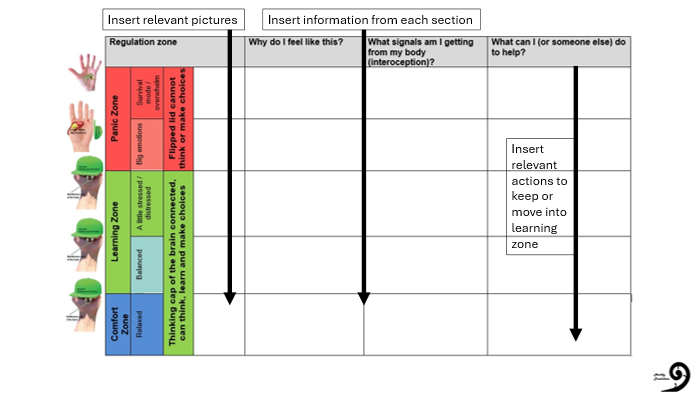
Now the information on these templates can be transferred to the full regulation template (below) and then over time the last column can be filled in, in collaboration with parent/carers and any relevant allied health professionals. The relevant pictures can be glued on as children select pictures from a basket containing a range of images that they might identify with.
Learners can be referred to their regulation scale throughout the day to check in how they are doing and if they are ready to learn or needing to energise or calm down. Explain that learning happens best when the brain’s “thinking cap” is connected and they are in or near the Learning Zone.
Here is an example of a completed regulation scale using pictures:
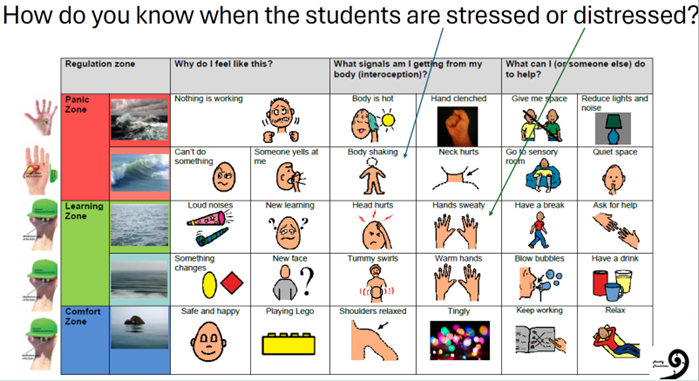
These resources have been provided for use by Healthy Possibilities.
It works better if:
- The children are already aware of and able to demonstrate the hand model of the brain.
- There is a class word wall of emotions/feelings on display
- Learner AAC devices have body parts, feelings and emotions
- A class basket of images is available for learners to pick to convey different states of being
It doesn’t work if:
- The story chosen doesn’t clearly convey big emotions or overwhelm
- The children are unable to name basic body parts
In the classroom
- Introduce the concept of ‘big emotions’ or overwhelm
- Read a story to the children that depicts big emotions or overwhelm for the main character.
- Discuss what happened and the emotional impact on the main character.
- Discuss how the learners could guess the characters feelings and emotions. What clues were there in the writing or pictures.
- Model describing the why and the body signals of big emotions and/or overwhelm. Use pictures, icons and/or words from a word wall as appropriate for the group.
- Complete the Panic Zone big emotions and/or overwhelm templates as individuals/group/class using pictures/icons/drawings/text. Adult support should be provided when required for students to complete one or both of the templates. Older learners may be able to use the whole regulation scale template instead of scaffolding each area.
- Review the regulation scale with parents/carers for additional input. Alter the regulation plan as required.
Practice toolkit
Practice implementation planner template
We know it's not always easy to keep track of what's working and what isn't. So, we've created this template for you to record and reflect on what you're doing to create more inclusive classrooms. The implementation planner contains:
- guidance around goal setting
- a reflection section (what worked, didn’t work, what to change, and next steps)
- prompting questions.
Implementation planner with examples
 Download
 Set your professional learning goal for:
Support foundational understanding of overwhelm
Benefits of goal setting
Setting, working towards, and reflecting on goals helps you grow professionally and improve your practice. You can access AITSL learning resources for teachers to learn more about:How to set goals
The Australian Institute for Teaching and School Leadership recommends using the SMART matrix to frame your goal setting.SMART goals refers to goals that are:
- Specific
- Measurable
- Achievable
- Relevant
- Time-phased
Resources
Downloadable pdf
https://youtu.be/8dcW0y0zxAg - Creating a regulation scale (Healthy Possibilities, 2026)
Related Practices

Meet students' sensory needs
TEACHING PRACTICE
For student years
Helps students to
- engage in tasks
- self-regulate
Model emotional literacy
TEACHING PRACTICE
For student years
Helps students to
- identify and respond to emotions
- regulate emotions
Use visual schedules
TEACHING PRACTICE
For student years
Helps students to
- transition smoothly
- understand expectations
- learn new concepts
Learning Cycle