Interact with every child (Early Childhood)
teaching practiceFor student year
Helps students to
- feel valued
- engage in interactions
Helps teachers to
- model strategies
- cater to strengths
Summary
In early learning settings, educators are often a child’s first structured social partner outside of the family. Some young learners, including neurodivergent children, may have difficulty with social interactions and need support to feel accepted and fit in. You can support these learners by planning genuine interactions when you structure the learning and social life of your learning and play spaces. Consistently warm, responsive, and well-planned interactions lay the foundation for social communication, emotional safety, and positive peer play.
How the practice works
Watch this video to learn more.
Duration: 2:45
Australian Children’s Education and Care Quality Authority (ACECQA) National Quality Standards (NQS) related to this practice
Element 1.1.2: Child centred
Each child’s current knowledge, strengths, ideas, culture, abilities and interests are the foundation of the program
Element 1.2.1: Intentional teaching
Educators are deliberate, purposeful, and thoughtful in their decisions and actions.
For further information, see ACEQA’s National Quality Standard page
Early Years Learning Framework (EYLF) outcomes related to this practice
Outcome 4: Children are confident and involved learners
Outcome 5: Children are effective communicators
For further information, see ACEQA’s Approved learning frameworks page
Preparing to teach
How does it help?
By engaging in positive and respectful interactions with every learner, you will be in a better position to cultivate meaningful relationships and build environments that are:
- well-regulated (predictable, calm, co-regulating)
- socially positive (welcoming, playful, strengths-based)
- inclusive (accessible to different communication styles and sensory needs).
Meaningful educator-learner relationships:
- are mutually respectful and warm
- are supportive and strengths-based
- increase learner engagement and confidence in play and routines
- promote social and emotional development.
Interactions can be verbal, non-verbal, or both (e.g., gesture, sign/Key Word Sign, AAC, facial expression, proximity).
Reflect and plan
- Relationships: reflect on your relationship with each child. Who seeks you out? Who needs more attuned, gentle approaches?
- Quality of interactions: are your interactions balanced, respectful, and responsive to cues?
- Family & team collaboration: talk with families, carers, and colleagues to identify each child’s motivators, interests, and comfort signals. You could develop a short “About me” card with: interests, preferred ways to communicate, “ready/not ready” signals, calming supports.
- Interaction goals: choose interactions that will support play, learning routines, and peer connections (e.g., turn-taking games, shared book-time, block play partnerships).
- Environment & materials: prepare visual supports (e.g., Now/Next, First-Then, greeting choices), choice boards with photos, sensory supports (e.g., quiet space, movement breaks), and play materials (balls, bubbles, scarves).
Plan your communication
Direct, rapid‑fire questions—especially closed questions that invite one‑word answers—can be hard to process or may shut down interaction. Instead, use descriptive commenting, wonder statements, choices, and “wait time” to invite richer engagement.
Direct questions (less effective in early childhood if overused)
- “How are you today?” → “Good.”
- “What are you building?” → “Robot.”
- “Do you like this book?” → “Yes.”
Descriptive, invitational language (more effective for sustained connection)
- “Hi Sam, I’m happy you’re here. We’ve got some fun things planned for today.”
- “I see a tall robot with shiny blocks. I wonder how it moves.”
- “You’re turning the pages carefully. I love the train picture—zoom!”
Helpful language habits
- Describe, don’t quiz: “You put the blue block on top—it’s so tall now!”
- Wonder aloud: “I wonder if the robot needs wheels or wings.”
- Offer choices (with visuals if required): “Playdough or cars?”
- Wait time: Speak briefly, then pause 5–10 seconds to allow processing.
- Echo and expand: Child: “Robot.” Educator: “Robot wheels—they must go fast!”
- Labelled praise: “Sam, you waited for your turn—that was kind.”
It works better if:
- there are frequent one-to-one interactions that include supporting play and peer interactions
- you take the learner’s unique abilities, interests, and needs into account when identifying and engaging in interactions
- the learner signals (possibly non-verbally) that he/she is ready to engage in an interaction
- you keep interactions brief, positive, predictable, and play-based.
It doesn’t work if:
- you insist on engaging with a learner who shows (verbally or non-verbally) that he/she is not interested in interacting or that the interaction is finished
- communication is based on a closed-questioning style or using rapid speech
- you engage in an interaction while angry or frustrated.
In the classroom
Understand every learner
Every educator-learner interaction is an opportunity to develop and enhance supportive relationships which can strengthen trust, communication, and social learning.
- Be aware of and respect each learner's abilities and needs.
- Get to know your learners' interests and passions.
- Respond to his/her own emotional states and communication styles.
- Create or identify the opportunities for genuine interaction with your learners throughout the day.
- Know how a learner signals (possibly non-verbally) that he/she is ready to engage in an interaction.
- Plan respectful exits when a child signals they are not ready for interaction, e.g. “Okay Sam, thanks for playing with me. I’m nearby if you need me.”
When you understand each learner's social, learning, sensory needs and stressors, you can prepare how to respond respectfully if a learner demonstrates that an interaction is not currently welcome.
Step 1. Engage one-to-one
- Check for readiness to engage in an interaction, such as approach, eye contact/glance, proximity, handing you a toy.
- Engage in one-to-one interactions with the learner as planned e.g., welcome the learner at the start of the day.
- Introduce topics that the learner is interested in. You can do this formally e.g., topic-based class news times or informally.
- Use descriptive commenting to open interaction and labelled praise where appropriate:
“Sam, that looks like a special sandcastle! I wonder who lives there.”
Step 2. Watch and follow the child's lead
- Observe first, then join beside the child (from parallel play to interactive play)
- Match their focus (blocks, sensory area, pretend kitchen) and mirror simple actions
- Use people‑play routines (roll ball back‑and‑forth, peekaboo, push‑pull cars) to build turn‑taking skills
- Expand gently by adding one small idea (a ramp, a sound effect, a new role in pretend play)
- Scaffold language by using echo and expand; pair words with gesture/visuals, e.g. Child: “Car.” Adult: “Red car—ready, set, go!”
Step 3. Scaffold peer interactions
- Encourage two‑person activities, such as rolling ball, musical instruments, ring stackers, etc.
- Prompt entry with scripts and visuals:
- Adult to child: You can say ‘My turn?’ or show a my turn card.
- Adult to peer: “Let’s save this block for Sam—thanks for waiting.”
- Model and narrate kindness and turn‑taking:
- “You gave Mia the blue bucket. That was nice.”
- Bridge parallel play: “Sam is cooking soup. Mia, you can bring the spoon.”
- Fade educator support as children sustain interaction for a few turns
Step 4. Respect stop/finished signals
- Learn the child’s stop/finished signals, such as turning away, covering ears, pushing item away, or moving to a quiet space.
- End warmly and clearly: “Thanks, Sam. Finished now. I’m nearby if you want more.”
- Offer an alternative, such as a quiet corner, movement break, or preferred solo play.
Step 5. Evaluate
- Evaluate interactions with a particular learner, such as:
- What worked (e.g., greeting choice, ball‑rolling turn‑takes)
- What didn’t (e.g., too noisy near block area)
- Next meaningful step (e.g., add “my turn” card; try quieter corner for start)
- Identify possible areas for improving the quality of the interaction.
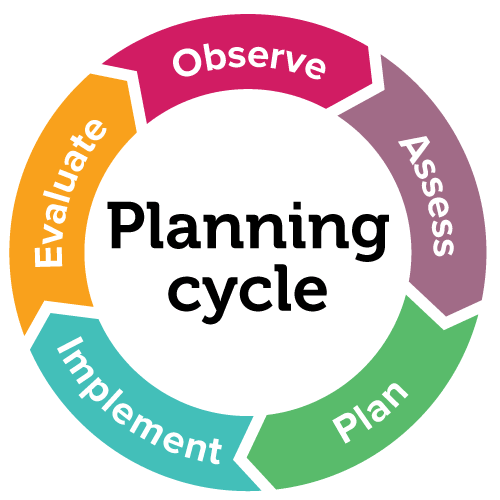
Use the EYLF Planning Cycle to interact with every child
- Observe: what cues a child uses to demonstrate ready/not ready for interaction and play; what interests the child has; and any sensory preferences or stressors
- Assess: what interaction strategies are currently working and where the child might need additional support
- Plan: select appropriate opportunities for intentional interaction and prepare visuals if required
- Implement: follow the child’s lead in interactions and be responsive to the needs in the moment
- Evaluate: any changes to the child’s interactions with educators or peers
How will I know if it’s working?
- The learner’s interactions with peers and educators are increasing in frequency
- The learner responds well to educator interactions
- The learner is engaged and motivated to come to the EC centre.
Practice toolkit
Practice implementation planner template
We know it's not always easy to keep track of what's working and what isn't. So, we've created this template for you to record and reflect on what you're doing to create more inclusive classrooms. The implementation planner contains:
- guidance around goal setting
- a reflection section (what worked, didn’t work, what to change, and next steps)
- prompting questions.
Implementation planner with examples
 Download
 Set your professional learning goal for:
Interact with every child (Early Childhood)
Benefits of goal setting
Setting, working towards, and reflecting on goals helps you grow professionally and improve your practice. You can access AITSL learning resources for teachers to learn more about:How to set goals
The Australian Institute for Teaching and School Leadership recommends using the SMART matrix to frame your goal setting.SMART goals refers to goals that are:
- Specific
- Measurable
- Achievable
- Relevant
- Time-phased
Resources
Related Practices

Harness learner interests (Early Childhood)
TEACHING PRACTICE
For student years
Helps students to
- be more engaged
- be motivated to learn and participate
- increase learning opportunities

Model emotional literacy (Early Childhood)
TEACHING PRACTICE
For student years
Helps students to
- feel secure and included
- identify and respond to emotions
- regulate emotion
Model positive interactions (Early Childhood)
TEACHING PRACTICE
For student years
Helps students to
- build social-awareness
- interact with others

Learning Cycle