Meet learner's sensory needs (Early Childhood)
teaching practiceFor student year
Helps students to
- engage in tasks
- self-regulate
Helps teachers to
- make adjustments
- support child's sensory needs
Summary
Young learners can be their best in inclusive learning environments that consider everyone's needs, including sensory preferences. While it’s difficult to cater to every preference, there are adjustments you can make to keep sensory stimuli at a level that allows your learners to feel comfortable, focussed, safe and ready to learn Observe and get to know your learners and their sensory preferences so you can create a more effective learning environment.
Neurodivergent children often have specific sensory needs that, when met, can help them self-regulate and engage more readily. Making suitable adjustments to accommodate the diverse range of sensory preferences ensures an inclusive environment that meets the learning needs of all children.
Sensory needs which are not met in the classroom environment can be particularly challenging for a neurodivergent learner and can sometimes present as inattentiveness, meltdowns, or inappropriate behaviour.
How this practice works
Watch this video to learn more about sensory needs.
Duration: 2:46
Australian Children’s Education and Care Quality Authority (ACECQA) National Quality Standards (NQS) related to this practice
Element 3.2.1: Inclusive environments
Outdoor and indoor spaces are organised and adapted to support every child's participation and to engage every child in quality experiences in both built and natural environments
For further information, see ACEQA’s National Quality Standard page
Early Years Learning Framework (EYLF) outcomes related to this practice
Outcome 3: Children have a strong sense of wellbeing
Outcome 4: Children are confident and involved learners
For further information, see ACEQA’s Approved learning frameworks page
Preparing to teach
Observe learner behaviour
Sensory processing differences can present a variety of challenges for neurodivergent learners. These learners may have difficulty processing information, paying attention, sitting still for extended periods, interacting with peers, keeping organised, and staying regulated.
Learners with sensory processing differences may have sensory needs relating to:
- hearing (auditory)
- seeing (visual)
- feeling (tactile, touch, temperature, body awareness)
- smelling (olfactory)
- taste (gustatory)
- vestibular (related to balance/movement)
- interoception (related to internal body signals such as pain and hunger) and
- proprioception (related to awareness of body position)
These needs are highly unique to the individual, and can change depending on the time of day, environment, or current levels of sensory input.
Some children are:
- hypersensitive: they experience overwhelmingly more sensory input than others, e.g., lights may seem too bright or noises too loud. This can result in sensory avoidance behaviour (trying to get away from this sensory input).
- hyposensitive: they are much less responsive to particular sensations and need more of that sensory stimulus to recognise the sensation and/or feel comfortable, e.g., dislike quiet spaces and prefer listening to music to concentrate. This can result in sensory seeking behaviour (trying to get more sensory input from the environment).
Observe learners, and speak with their parents/carers, and specialists
Sensory needs vary from person to person. Observing and speaking with learners, parents/carers, and specialists such as therapists will help you to:
- identify sensory needs and appropriate sensory supports
- gain advice on a range of adjustments and supports.
It works better if:
- the educator observes the learner and asks age-appropriate questions about their experience
- the educator asks for input from the parents/carers, and specialists about the learner’s sensory supports
- embeds strategies that have worked well for the child in other environments
It doesn't work if:
- the educator assumes all autistic or neurodivergent children have the same sensory preferences
- the educator guesses what sensory support might be useful for the learner without consultation
- the educator removes sensory supports to punish the learner.
In the classroom
How do I do it?
Potential adjustments for the ECEC setting
Adjustments for hypersensitive sensory processing include:
- using a filter or light covers, dimmable lights or turning off a bank of lights
- allowing learners to wear a hat or sunglasses inside if the lights are unable to be changed
- offering noise-cancelling headphones in noisy environments
- offering a variety of seating options, if learners prefer to sit somewhere where they won’t be touched
- offering a quiet, dark, sensory-free space for the learner to self-regulate.
Adjustments for hyposensitive sensory processing include:
- using visual supports to explain verbal directions
- allowing or offering fidget toys or other sensory tools (note: ensure that they are not noisy so as to distract others)
- offering headphones so learners can listen to music while they play
- create a sensory space with different tactile items
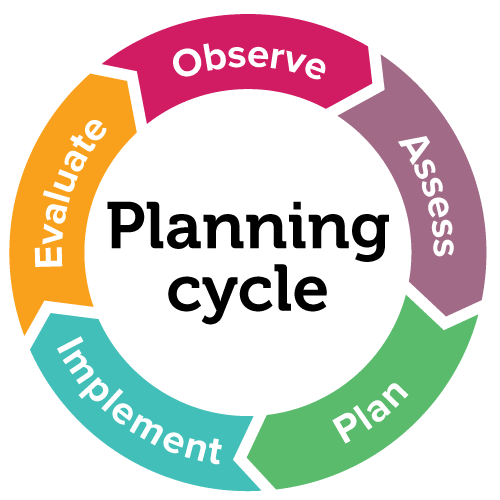
Use the EYLF Planning Cycle to meet learner’s sensory needs
- Observe: the child’s sensory needs and how their preferences affect their learning, behaviour, interactions and engagement.
- Assess: the existing environment and ask parents/carers and specialists about the child’s sensory preferences at home and other environments where they live, learn and play
- Plan: consider how the environment can be modified and/or organised to support children’s sensory needs and establish individualised goals with the parent/carer and any specialists that may be involved
- Implement: the necessary adjustments to the environment and materials
- Evaluate: the impact of the adjustments on the child’s learning, behaviour, interactions and engagement
How will I know if it’s working?
- Children feel safe and ready to learn
- Children know that their sensory preferences are being recognised
- Children have increased engagement and attention to task, and a decrease in unexpected behaviours
- Educators feel confident in identifying and responding to individual sensory preferences by making suitable adjustments
- Educators, parents/carers and any specialists are communicating about the child’s sensory preferences
- Educators have the knowledge, skills and confidence to introduce and adapt materials and the environment to meet children’s sensory preferences.
Practice toolkit
Set your professional learning goal for:
Meet learner's sensory needs (Early Childhood)
Benefits of goal setting
Setting, working towards, and reflecting on goals helps you grow professionally and improve your practice. You can access AITSL learning resources for teachers to learn more about:How to set goals
The Australian Institute for Teaching and School Leadership recommends using the SMART matrix to frame your goal setting.SMART goals refers to goals that are:
- Specific
- Measurable
- Achievable
- Relevant
- Time-phased
Resources
Sensory Audit Checklist - Primary
Use this simple Sensory Audit Checklist for primary teachers in your own or new classrooms to ensure an optimal sensory learning space.
 Download
Related Practices
Improve your classroom's acoustics
TEACHING PRACTICE
For student years
Helps students to
- hear in the classroom
Prepare children for transitions (Early Childhood)
TEACHING PRACTICE
For student years
Helps students to
- manage transitions
- decrease anxiety during transitions
- increase engagement

Learning Cycle